.png?x-oss-process=image/resize,h_100,m_lfit/format,webp)
.png?x-oss-process=image/resize,h_100,m_lfit/format,webp)
.png?x-oss-process=image/resize,h_100,m_lfit/format,webp)
In large-scale soybean processing projects, the initial equipment purchase price is no longer the primary concern for investors. Instead, subsequent consumption often determines whether investment costs will increase. The overall operating cost per ton of product dictates whether the project can proceed. While many investors are attracted by low purchase prices, they often find after the project starts operating that outdated equipment leads to increasingly higher costs and energy consumption, resulting in revenue not matching expenditures.
In its analysis of hundreds of oil and grease treatment plant cases, QIE GROUP found that many plants were not as profitable as they had initially estimated, and were actually experiencing declining profits. If your plant is facing operational difficulties, it is very likely due to an inefficient solvent recovery system .
1. Cost reasons for excessive solvent loss in soybean oil extraction
In solvent extraction workshops, solvent loss (solvent consumption) is a key indicator of a production line's sophistication; more advanced extraction lines consume less solvent. In large-scale production lines, high solvent loss rates in soybean oil extraction can lead to substantial annual financial deficits.
- ● Low-cost equipment: Solvent consumption is typically as high as 3–4 kg/t or even higher.
- ● QIE GROUP Standard: Our system, through process optimization, can reduce solvent consumption to approximately 1.5 kg/t.
- ● Economic Considerations: Taking a factory with a daily output of 1,000 tons as an example, if solvent consumption is reduced from 4 kg/t to 1.5 kg/t, 2.5 tons of solvent can be saved per day. Based on 300 production days per year, this translates to a net profit recovery of 750 tons per year.
2. Why is technical precision far more important than procurement price?
True efficiency stems from a deep understanding of soybean processing technology. Soybean extraction lines are not simply built and then forgotten; there is also ongoing maintenance, solvent consumption, and other factors.
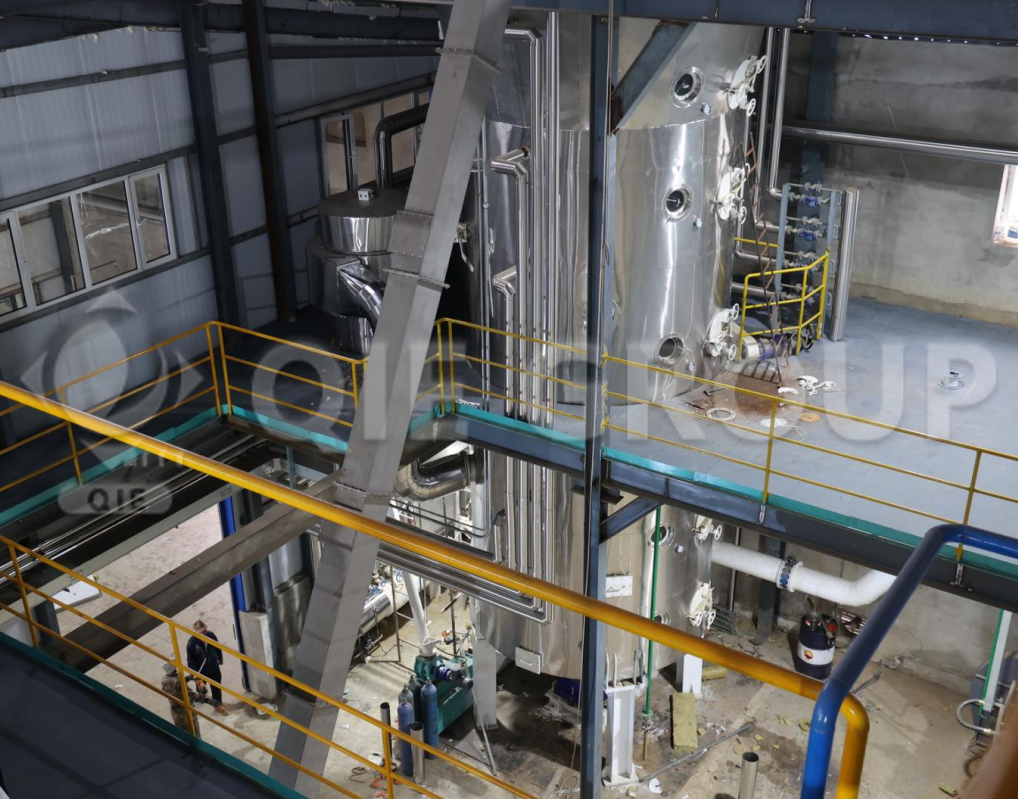
The impact of DTDC desolventizer on solvent recovery efficiency
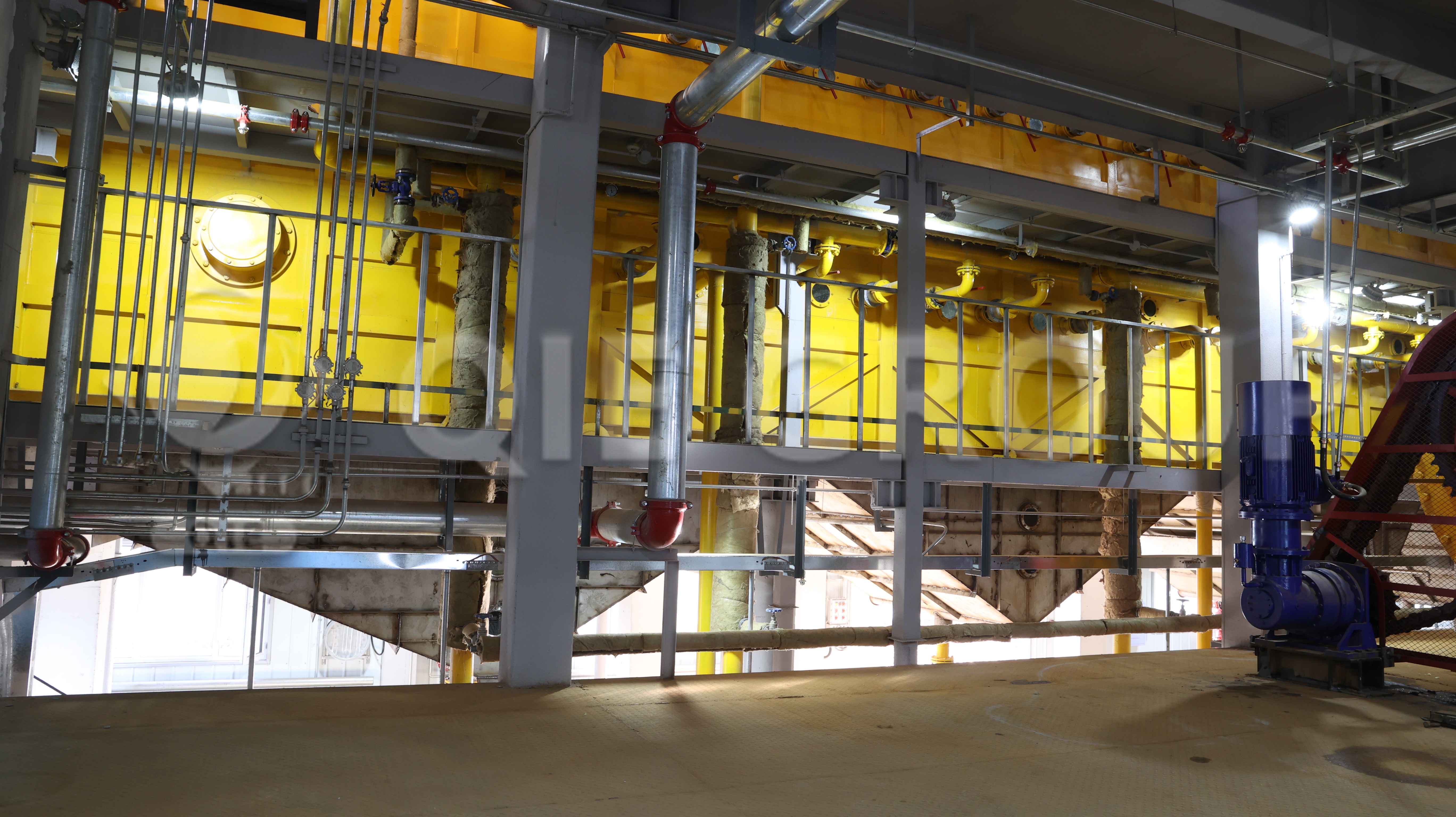
The DTDC (Descaling Dryer/Cooler) is the core of the entire leaching workshop. Inferior DTDC equipment often suffers from uneven steam distribution, directly leading to:
- Excessive residual solvent in meal: The solvent cannot be completely evaporated in the descaling section, which not only wastes expensive n-hexane, but also poses a safety hazard.
- Protein denaturation: Unstable temperature control can damage the NSI (nitrogen solubility index) of soybean meal, causing your soybean meal to not fetch a good price in the high-end feed market.
- QIE Solution: Our intelligent evaporation system protects protein quality while ensuring typical residual oil levels are controlled at 0.6–0.8%.
High-efficiency condensation and exhaust gas absorption technology
Many low-cost suppliers simplify their paraffin oil absorption units or use condensers with insufficient heat exchange area. QIE GROUP employs a two-stage condensation combined with tail gas adsorption technology to ensure a solvent recovery rate of ≥99% and achieve fully enclosed negative pressure operation, eliminating any risk of leakage.
3. Selection Criteria for Complete Soybean Extraction Equipment
1. Immersion equipment flexibility
Select either a drag chain or ring leaching device based on production capacity to ensure uniform solvent penetration and sufficient residence time of the material layer.
2. Cascaded utilization of energy
The system needs to have multi-stage heat exchange and waste heat recovery functions to reduce energy consumption by 10-15% compared with traditional equipment.
3. High-intensity work capacity
Leveraging its 130,000 square meter manufacturing capacity, the equipment is specifically designed for continuous industrial operation, ensuring stable 24/7 operation.
4. How to reduce solvent loss in oil leaching workshops: Expert suggestions
- Detect negative pressure status: Ensure the entire system operates under fully enclosed negative pressure to prevent solvent vapor from escaping.
- Optimize steam pressure: Precisely control the steam ratio in the first steaming, second steaming, and stripping sections.
- Upgrade exhaust gas recovery: Install a high-efficiency exhaust gas recovery tower to capture the last bit of solvent before the gas is emitted.
💡 Frequently Asked Questions about Soybean Oil Extraction Lines
Q1: What solvent consumption index is considered "high efficiency" in soybean processing?
Under modern industrial standards, the solvent consumption per ton of a high-efficiency plant should be controlled between 1.2 and 1.5 kg/t. If your loss exceeds 2.5 kg/t, it indicates a serious technical defect in the recovery system.
Q2: How does the DTDC system affect the market value of soybean meal?
DTDC is responsible for the solvent removal and baking processes. Improper temperature control can denature soybean meal proteins (reducing NSI). A precise system can remove the solvent while maintaining high digestibility of the soybean meal.
Q3: Can I upgrade the recycling system without replacing the entire production line?
Yes. Condensation efficiency can be significantly improved by installing a high-efficiency paraffin oil exhaust gas absorption system or optimizing the multi-stage evaporation path.
Q4: Why does the leaching workshop emphasize "negative pressure operation"?
Negative pressure ensures that solvent vapors do not leak. This not only allows for solvent recovery and cost savings, but is also crucial for meeting explosion-proof standards and protecting health.
Q5: Which type of extractor should be selected for large-scale soybean processing?
For high-capacity production lines, drag chain or annular leaching machines are generally preferred. They support greater bed thickness and better penetration, ensuring that residual oil remains stable below 1.0%.